
Guide
Race-day stomach problems, why they happen and the five fixes
Educational content, not medical advice. Individual tolerance varies; persistent GI symptoms, blood in the stool, or any race-related medical concern should be reviewed by a sports dietitian or doctor.
Exercise-associated gastrointestinal distress is the set of stomach and gut symptoms, nausea, bloating, reflux, cramps, gas and the urgent need for a toilet, that appear during prolonged hard exercise and are driven by reduced blood flow to the gut, the mechanical jolt of running and what the athlete has eaten. It affects 30 to 50 percent of endurance athletes in a typical event, rising to around 90 percent in long-distance triathlon, and it is the single most common reason a fueling plan is abandoned mid-race.
Everyone who has raced long enough has a version of the story. The plan was fine for two hours and then a gel sat in the stomach like a stone, or the gut cramped at 30 km and the next 12 were spent looking for a portable toilet. The usual conclusion is "my stomach cannot handle gels", and the usual response is to take less fuel next time, which produces a different failure at a different kilometre.
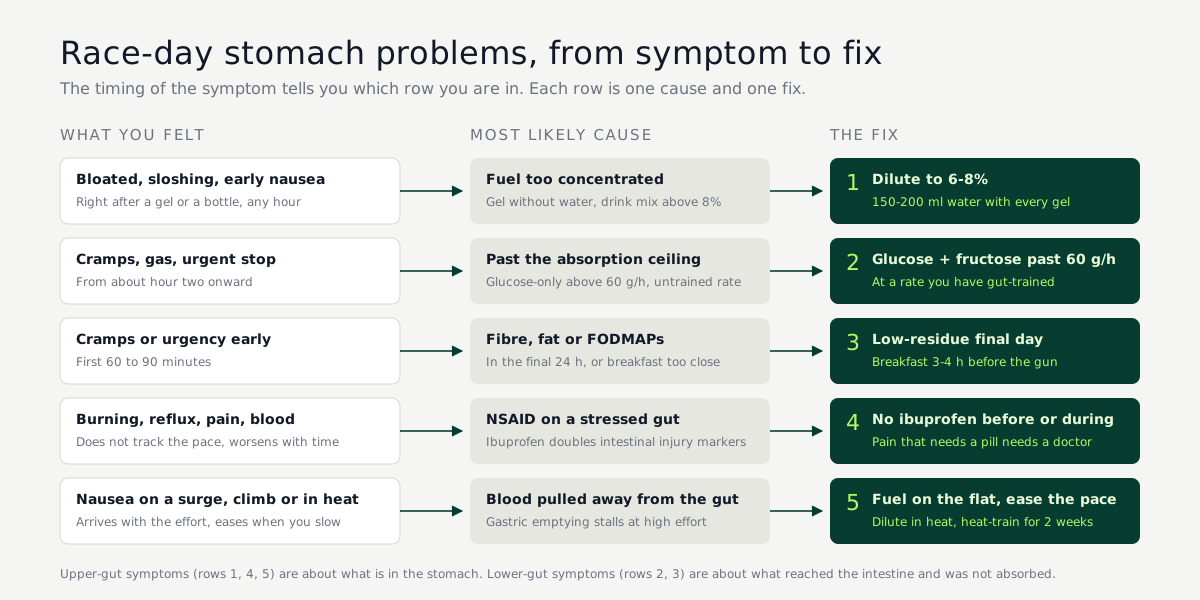
The better conclusion is that the gut failed for a reason, and that the reason is nearly always one of five. This guide is organised to find yours. The table below goes from the symptom you felt to the cause behind it, and the rest of the page takes each fix in turn. If you already know you have a weak gut and want the training protocol, the gut training guide is the 4-week plan; this page is what to do when the gut has already told you something went wrong.
Start with the symptom
| What you felt | When | Most likely cause | The fix |
|---|---|---|---|
| Bloated, sloshing stomach, fuel "sitting there", early nausea | Any time, often right after a gel or a bottle | Fuel too concentrated: a gel without water, a drink mix well above 8 percent, or gel plus sports drink together | 1. Concentration |
| Lower cramps, gas, urgent toilet stop, loose stool | From about hour two onward | Carbohydrate past the gut's absorption ceiling: glucose-only above 60 g/h, or a rate the gut has never been trained for | 2. Rate and ratio |
| Cramps, bloating or urgency early, before the fuel could be the problem | First 60 to 90 minutes | Fibre, fat, protein or high-FODMAP foods in the final 24 hours, or breakfast too close to the gun | 3. The last 24 hours |
| Burning, reflux, stomach pain, nausea that does not track the pace, blood | Any time, worse as the race goes on | An NSAID such as ibuprofen taken before or during, on a gut already short of blood | 4. Painkillers |
| Nausea or a heavy stomach that arrives on a surge, a climb or in heat, and eases when you slow down | Tied to effort | Blood pulled from the gut to the muscle and skin; gastric emptying stalls | 5. Pace and heat |
Two patterns cover most races. Upper-gut symptoms (nausea, reflux, bloating, the feeling that nothing is going down) are about what is in the stomach and how fast it can leave: concentration, volume, pace and heat. Lower-gut symptoms (cramps, gas, urgency, diarrhoea) are about what reached the intestine and could not be absorbed: rate, carbohydrate type, and what you ate the day before. Runners get far more of the second kind; in a survey of over 600 trained athletes, 71 percent of runners reported lower-gut symptoms during exercise against 36 percent for upper-gut, while cyclists split evenly between the two.
Why the gut fails under race load
Three things happen at the same time once you are racing hard, and none of them are your fault.
Blood leaves the gut. At high intensity the body sends blood to the working muscle and, in heat, to the skin. Flow to the splanchnic circulation that feeds the stomach and intestine falls sharply, by as much as 80 percent in some studies. Less blood means slower gastric emptying, less absorption and, if it goes on long enough, a gut wall that becomes leaky. A 2017 systematic review put the threshold where measurable gut disturbance appears at about two hours at 60 percent of VO2max, which is to say most of the races on this site, with heat and running both making it worse.
Running shakes everything. Each stride is a controlled collision, and the stomach contents, the intestine and the vessels that supply them all take the jolt. This is why a drink that sits fine on the bike comes back up on the run of a triathlon, and why the cycling versus running guide gives runners a lower hourly ceiling.
Then you add fuel. Carbohydrate, fluid, caffeine and sometimes painkillers all land on a gut that is working at a fraction of its resting capacity. This third factor is the only one you control on the day, and it is where all five fixes live. The physiology and the mechanics are the reason the margin is thin; the nutrition is what decides whether you cross it.
Fix 1: Concentration
The most common cause of a stomach that "will not take gels" is not the gel. It is the gel without water.
The stomach empties fastest when what is in it is close to the concentration of body fluid, roughly a 6 to 8 percent carbohydrate solution. Anything much denser has to be diluted before it can leave, and the stomach does this by pulling fluid in from the body, which is the sloshing, heavy feeling, and often the nausea. A gel is extremely concentrated carbohydrate: across the 366 gels we track, the typical sachet carries about 30 g of carbohydrate in 40 to 60 g of gel, which is many times denser than an isotonic drink. Even the gels marketed as "isotonic", which use long-chain maltodextrin to keep their osmolality low, are still a dense carbohydrate load and empty better with fluid.
The 1992 study that first measured this in triathletes found that 40 percent of those who had drunk a hypertonic beverage reported severe complaints, against 11 percent of those on an isotonic or hypotonic one, and four of the five athletes with stomach pain had used a strongly hypertonic drink. Modern high-carb drink mixes are deliberately hypertonic for a reason, they let you carry 80 g of carbohydrate in one bottle, but they are a product for a trained gut. Of the 112 drink mixes in the catalogue, 22 state a bottle volume on the label; 13 of those sit above 10 percent and 11 at 14 percent or more, with the densest at 18 percent (90 g in 500 ml). 18 of the 112 carry 60 g or more per serving.
In practice:
- Take every standard gel with 150 to 200 ml of water. Not with a sports drink: a gel plus a bottle of 8 percent drink is a hypertonic load whichever way you count it. At an aid station that only offers sports drink, take the gel with the water cup and skip the drink, or take the drink and skip the gel.
- Know your bottle's percentage. Grams of carbohydrate divided by millilitres, times 100. 40 g in 500 ml is 8 percent and sits comfortably; 80 g in 500 ml is 16 percent and needs the gut training to match. The sports drink guide goes through the zones.
- Do not fix a slow stomach by adding more. If a dose is sitting there, the next one will sit on top of it. Sip water, hold the next gel until the stomach clears, then resume, possibly at a smaller dose. A 20 to 25 g gel or a few chews at a time is often all the difference between "cannot take gels" and a finished plan; 100 of the 327 gels with a stated dose are 25 g or under.
- Drink-style gels need no extra water; 93 of the 366 are liquid format. They are the easiest fix for the runner whose problem is remembering to drink with the gel.
Fix 2: Rate and ratio
Lower-gut symptoms that arrive from hour two onward are usually carbohydrate that reached the intestine and could not be absorbed. Unabsorbed carbohydrate pulls water into the bowel and ferments, which is cramps, gas, urgency and loose stool in that order.
The reason is a ceiling. Glucose and maltodextrin cross the intestinal wall through a transporter called SGLT1, and SGLT1 saturates at roughly 60 g per hour. Take more glucose than that and the excess simply stays in the gut. Fructose uses a different transporter, GLUT5, so a product that mixes the two can move carbohydrate across at up to about 90 g per hour, and in well-trained athletes exogenous oxidation above 100 g per hour has been measured. This is the whole case for the glucose-fructose products that now dominate the shelf, and the detail is in the maltodextrin and fructose ingredient pages.
So the rule has two halves. Under 60 g per hour, carbohydrate type barely matters for your stomach, and the glucose-only products are fine. Over 60 g per hour the product must be a glucose-fructose mix, ideally around 2:1 to 1:0.8 glucose to fructose, and the rate must be one you have practised. Of the 366 gels, 208 are glucose-fructose, 29 are glucose-only and 129 do not state enough on the label to tell; if you are planning 80 or 90 g per hour on a gel whose label does not say, you are guessing, and the gel guide explains how to read the ingredients instead.
Two cautions sit inside this fix. The first is that fructose alone is its own problem: GLUT5 has limited capacity and a large dose of fructose on its own is malabsorbed and osmotically active, which is why fruit juice and honey as the main race fuel so often end in the bushes. The ratio matters in both directions. The second is more surprising. In the largest field study of race-day intake, 221 athletes across Ironman, 70.3, marathon and cycling events, higher carbohydrate intake correlated with more nausea and flatulence, and also with faster finishing times. The athletes who fuelled hardest felt it and still won on it. The answer to lower-gut symptoms is therefore not "take less"; it is "take what your gut has been trained to absorb". Two weeks of repeated gut-challenge, 30 g every 20 minutes during 2-hour runs, cut symptoms by about 60 percent and improved a 1-hour distance test by 5 percent against placebo. The gut training guide turns that into a 4-week protocol, and the carbs-per-hour guide sets the target you are training toward.
Fix 3: The last 24 hours
If the symptoms arrived early, in the first hour or so, before any in-race fuel could plausibly be the cause, look at the day before and the morning of.
The final day of a carb load has one job: fill the glycogen store with as little residue as possible. The things that leave residue are fibre, which ferments and holds water in the bowel, fat and protein, which slow gastric emptying and were associated with vomiting in the triathlon survey above, and the group of fermentable short-chain carbohydrates known as FODMAPs: fructans in onion, garlic, wheat in large amounts and many legumes, lactose in milk and soft cheese for those who cannot digest it, excess fructose in apples, pears and honey, and the polyols in some sugar-free sweets. The same triathlon study found every athlete with intestinal cramps had eaten a fibre-rich pre-race meal, against 10 percent of those without cramps. A randomised crossover in runners with a history of exercise GI symptoms found six days of a low-FODMAP diet reduced daily symptoms, with flatulence, urgency, loose stool and diarrhoea all significantly lower than on a high-FODMAP diet. And when 137 endurance athletes with recurring symptoms were asked what actually worked, fibre reduction, low-FODMAP eating and dairy avoidance were the most used strategies and all rated four out of five for success.
The practical version:
- Carb-load from low-residue sources in the final 24 hours: white rice, pasta, white bread, potato without skin, rice cakes, bananas, juice, sports drink. The quantity is the marathon guide's 8 to 12 g per kg; the sources are the change.
- Move the fibre and the big salads, the beans, the onion and garlic, the wholegrains and the large dairy servings to after the race. This is a 24-to-48-hour adjustment, not a diet. Low-FODMAP eating is restrictive and should not run for weeks without a dietitian.
- Breakfast three to four hours before the start, low in fat and fibre, from foods you have tested before long runs. In the triathlon survey every athlete who had eaten within 30 minutes of the start vomited during the swim. The race-day timeline places the breakfast, the top-up and the cut-off minute by minute.
- Caffeine on an empty stomach is a known irritant for some people. If your morning dose comes as coffee, drink it with the breakfast rather than before it, and read the caffeine guide for dosing.
Fix 4: Painkillers
A surprising number of athletes take ibuprofen or another NSAID before the gun, to pre-empt the pain they know is coming. On a gut already short of blood this is close to the worst thing you can swallow.
In a controlled trial, trained men took 400 mg of ibuprofen twice before a cycling test. The blood marker of small-intestine injury (I-FABP) after cycling with ibuprofen was roughly double the level after cycling alone, and higher than ibuprofen at rest; small-intestine permeability rose the most in the ibuprofen-plus-exercise condition, and injury and permeability correlated with each other. The authors' conclusion was blunt: NSAID consumption by athletes "is not harmless and should be discouraged." The leaky gut that results is also the route by which bacterial endotoxin enters the blood during ultra-endurance events; in one long-distance triathlon study 93 percent of finishers reported GI symptoms, 45 percent severe, and 68 percent showed mild endotoxaemia at the finish.
Add to that the kidney risk of NSAIDs in a dehydrated athlete, and the hyponatraemia risk they carry when combined with over-drinking, and the rule writes itself: no ibuprofen, naproxen, diclofenac or aspirin in the 24 hours before or during a race. Paracetamol acts by a different mechanism and does not carry the same gut effect, but it is still a drug on a stressed system, and if you need any painkiller to start a race the question to ask a doctor is about the start, not the pill.
Fix 5: Pace and heat
The last cause is the one you cannot fully fix, only manage. When you surge, climb or race in heat, blood flow to the gut drops further and gastric emptying stalls. Whatever is in the stomach stays there, and nausea follows. The tell is timing: this kind of nausea arrives on the effort and eases when the effort does.
- Fuel on the flat, not on the climb. Take the gel before a hill or after it, in a stretch where the pace is steady. Triathletes should take most of the day's carbohydrate on the bike, where the gut is calm, and shift to small frequent doses on the run; the cycling versus running guide has the per-leg numbers.
- Front-load the first half. The gut absorbs best early, before heat and fatigue have accumulated. A plan that takes the same dose every 30 minutes for four hours is asking the most of the gut when it has the least to give. Start on schedule from minute 20 to 30 and expect to lean on smaller, more frequent doses, or on fluid carbohydrate, in the last third.
- In heat, dilute. Hot races need more fluid and tolerate less concentration. Drop a 10 percent bottle to 6 percent and make up the carbohydrate from gels with water, drink to a plan rather than to thirst, and if the heat is outside your training range, two weeks of heat training measurably improves gut tolerance as well as everything else.
- When nausea hits, do not push through it with another gel. Ease the pace for 30 to 60 seconds, sip water, skip the next scheduled dose, then resume at half-dose once the stomach settles. Stopping fuel entirely trades a stomach problem at 25 km for a bonk at 35.
Pacing discipline is a fueling tool. The runner who goes out 20 seconds per kilometre too fast is not only spending glycogen; they are closing the gut for the hour when they most need it open.
When it is not the fueling
Most race-day gut trouble is one of the five above. Some of it is not, and it matters to know the difference. Blood in the stool or vomit, symptoms that persist at rest or between sessions, unexplained weight loss, severe pain, or symptoms that appear on every run regardless of what you eat are reasons to see a doctor rather than to change gels. Coeliac disease, inflammatory bowel disease and irritable bowel syndrome all show up first in training for some athletes, and all of them need a diagnosis before a fueling plan can work around them. A sports dietitian is the right person for the fueling side once that is done; the athletes in the strategy survey rated dietitians as their most important source of information for a reason.
Build the tolerance before you need it
Everything above is what to do when the gut has already failed. The better position is not to arrive there. Three habits cover it:
- Train the gut. Two to four weeks of taking race-day fuel at race-day rates during long sessions. The gut training guide is the protocol.
- Rehearse the exact plan, products, doses, minutes and the water with each gel, in at least one long session at race intensity. The gut is specific: a different brand at an aid station is an untested product.
- Write down what went wrong and when. The timing of the symptom is the diagnosis. A note that says "nausea from minute 95, after the second gel taken with sports drink" solves itself. If you planned your race with the Grams Per Hour planner, the post-race debrief captures exactly this and carries it into the next plan.
Get a plan for your race
To put the rates, the water and the timing into one schedule, open the Grams Per Hour planner: put in your race, your goal time and your bodyweight, and it returns a carb, sodium and fluid plan by kilometre, holding the hourly rate under your trained ceiling and pairing every gel with its fluid. The first plan is free with no signup.
Frequently asked questions
Why do I get stomach problems during a race?
Three things happen at once. Hard exercise pulls blood away from the gut toward the working muscle, the stomach empties more slowly and the intestine absorbs less, and running adds a mechanical jolt on every stride. Onto that reduced capacity you load carbohydrate, fluid and sometimes painkillers. Studies put the prevalence at 30 to 50 percent of endurance athletes, rising to around 90 percent in long-distance triathlon. Of the causes, the physiology is fixed and the mechanics come with the sport, which leaves the nutritional ones, and those are the five fixes in this guide.
How do I stop diarrhoea during a marathon?
Lower-gut symptoms, cramps, gas and the urge to go, are usually carbohydrate that was not absorbed. Common causes are a glucose-only product taken above about 60 g per hour, an untrained gut asked for a rate it has never seen, a fibre-rich or high-FODMAP meal in the final 24 hours, or an NSAID taken before the start. Fix the one that matches your timing. Symptoms in the first hour point to the day before; symptoms from hour two onward point to the rate and type of fuel you are taking.
Why do gels make me feel sick?
Almost always concentration. A gel is a dense carbohydrate paste, and if it lands in a stomach with no water alongside it, the stomach has to pull in fluid before it can empty, which feels like sloshing, fullness and nausea. Take every standard gel with 150 to 200 ml of water, never with a sports drink, and if you are running near threshold consider a smaller 20 to 25 g dose or chews taken in pieces. If the nausea comes on during a surge or climb, it is blood flow, not the gel, and easing the pace for a minute usually clears it.
What should I not eat the day before a race?
Large amounts of fibre, fat and the fermentable carbohydrates known as FODMAPs. In one study every triathlete who reported intestinal cramps had eaten a fibre-rich pre-race meal, against 10 percent of those without cramps, and vomiting was associated with higher fat and protein intake. Keep the carb load coming from low-residue sources such as white rice, pasta, bread, potato without skin and juice, and move the salad, beans, onion, garlic, high-fibre grains and large dairy servings to after the race. Eat breakfast three to four hours before the start.
Can I take ibuprofen before a race?
It is a bad idea. In a controlled trial, 400 mg of ibuprofen twice before cycling roughly doubled the blood marker of small-intestine injury compared with cycling alone, and increased gut permeability. The authors concluded NSAID use by athletes should be discouraged. Pre-race NSAIDs also carry a kidney risk when combined with dehydration. If you cannot start a race without a painkiller, the problem is the start, not the pill, and it belongs with a doctor.
How much carbohydrate per hour can the gut absorb?
About 60 g per hour from glucose or maltodextrin alone, because the glucose transporter in the intestine saturates there. Adding fructose, which uses a different transporter, lifts the ceiling to around 90 g per hour and in trained athletes beyond 100 g. Anything above your ceiling sits in the intestine, pulls in water and ferments, which is what cramps, gas and diarrhoea are. Past 60 g per hour the product has to be a glucose-fructose mix and the rate has to be rehearsed.
Does gut training actually reduce GI symptoms?
Yes, and the effect is large. Two weeks of taking 30 g of carbohydrate every 20 minutes during 2-hour runs reduced gastrointestinal symptoms by about 60 percent and improved a 1-hour distance test by 5 percent against placebo, with less carbohydrate malabsorption on breath testing. A 2023 systematic review found gut discomfort fell by an average of 47 percent across 2-week repetitive feeding protocols. The gut adapts to what it is given, so give it race-day fuel at race-day rates before race day.
Research and references
The mechanisms, prevalence figures and thresholds in this guide rest on the following peer-reviewed sources. Verify dose, side-effect profile, and contraindications against the primary literature.
- de Oliveira EP, Burini RC, Jeukendrup A. 2014. Sports Medicine. Gastrointestinal complaints during exercise: prevalence, etiology, and nutritional recommendations. PMID 24791919
- Costa RJS, Snipe RMJ, Kitic CM, Gibson PR. 2017. Alimentary Pharmacology & Therapeutics. Systematic review: exercise-induced gastrointestinal syndrome, implications for health and intestinal disease. PMID 28589631
- Pfeiffer B, Stellingwerff T, Hodgson AB, et al. 2012. Medicine & Science in Sports & Exercise. Nutritional intake and gastrointestinal problems during competitive endurance events. PMID 21775906
- Peters HP, Bos M, Seebregts L, et al. 1999. American Journal of Gastroenterology. Gastrointestinal symptoms in long-distance runners, cyclists, and triathletes: prevalence, medication, and etiology. PMID 10364027
- Rehrer NJ, van Kemenade M, Meester W, Brouns F, Saris WH. 1992. International Journal of Sport Nutrition. Gastrointestinal complaints in relation to dietary intake in triathletes. PMID 1338583
- Jeukendrup AE, Vet-Joop K, Sturk A, et al. 2000. Clinical Science. Relationship between gastro-intestinal complaints and endotoxaemia, cytokine release and the acute-phase reaction during and after a long-distance triathlon in highly trained men. PMID 10600658
- Jeukendrup AE. 2010. Current Opinion in Clinical Nutrition and Metabolic Care. Carbohydrate and exercise performance: the role of multiple transportable carbohydrates. PMID 20574242
- Jeukendrup AE. 2014. Sports Medicine. A step towards personalized sports nutrition: carbohydrate intake during exercise. PMID 24791914
- de Oliveira EP, Burini RC. 2014. Nutrients. Carbohydrate-dependent, exercise-induced gastrointestinal distress. PMID 25314645
- Van Wijck K, Lenaerts K, Van Bijnen AA, et al. 2012. Medicine & Science in Sports & Exercise. Aggravation of exercise-induced intestinal injury by ibuprofen in athletes. PMID 22776871
- Lis DM, Stellingwerff T, Kitic CM, Fell JW, Ahuja KDK. 2018. Medicine & Science in Sports & Exercise. Low FODMAP: a preliminary strategy to reduce gastrointestinal distress in athletes. PMID 28891824
- Scrivin R, Costa RJS, Pelly F, Lis D, Slater G. 2022. Frontiers in Nutrition. An exploratory study of the management strategies reported by endurance athletes with exercise-associated gastrointestinal symptoms. PMID 36438762
- Costa RJS, Miall A, Khoo A, et al. 2017. Applied Physiology, Nutrition, and Metabolism. Gut-training: the impact of two weeks repetitive gut-challenge during exercise on gastrointestinal status, glucose availability, fuel kinetics, and running performance. PMID 28177715
- Martinez IG, Mika AS, Biesiekierski JR, Costa RJS. 2023. Sports Medicine. The effect of gut-training and feeding-challenge on markers of gastrointestinal status in response to endurance exercise: a systematic literature review. PMID 37061651
- Jeukendrup AE. 2017. Sports Medicine. Training the gut for athletes. PMID 28332114