
Guide
Half marathon fueling, do you need gels at all?
Educational content, not medical advice. Individual tolerance varies; persistent GI symptoms or any race-related medical concern should be reviewed by a sports dietitian or doctor.
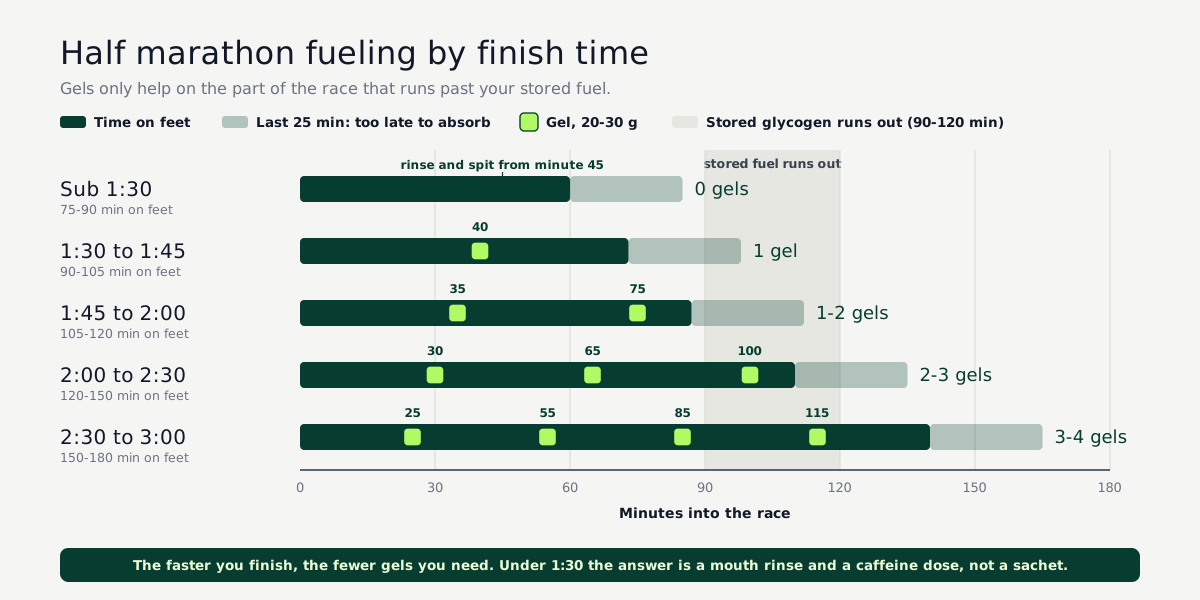
Half marathon fueling is the practice of covering a 21.1 km race that lasts 75 minutes to three hours with a glycogen store that lasts roughly 90 to 120 minutes of hard running. Runners who finish inside that window need no carbohydrate during the race beyond a mouth rinse; runners who finish outside it need 0 to 60 g of carbohydrate per hour, started between minutes 30 and 45, scaled by how long they will be out there.
The half is the most-run race distance in the world and the one with the least clear fueling advice, and those two facts are related. A marathon runs you empty, so everyone agrees you have to eat. A 10K finishes on the fuel you started with, so nobody argues you should. The half sits exactly on the line between them, which is why the same race gets fuelled like a marathon by one runner and like a 10K by the next, and both of them can be right.
The variable that decides it is not the distance. It is how long you will be running, so this guide is organised by finish time. For the ladder across every other distance see fueling by race distance; this page is the half in full.
The half sits on the edge of the glycogen window
A trained runner stores roughly 90 to 120 minutes of hard-effort carbohydrate as muscle and liver glycogen, somewhere around 1,500 to 2,000 kcal. Running costs about 1 kcal per kg of bodyweight per km, so a 70 kg runner spends roughly 1,480 kcal covering 21.1 km. Put those numbers side by side and the half looks like a race you can finish on stored fuel, and for a well-loaded runner finishing inside 90 minutes it is.
The margin is the problem. Half marathon pace is a high-carbohydrate intensity, close to threshold for most runners, so almost all of that 1,480 kcal is coming from carbohydrate rather than fat. If you started with a full tank you have enough. If you skipped the carb load, trained hard the day before, or raced on an empty stomach, you do not, and the gap shows up as the familiar sag over the last 5 km that most people blame on pacing.
So the first rule of half marathon fueling has nothing to do with gels: arrive full. The second rule is that what you do during the race depends entirely on whether you cross the 90 to 120 minute line, which is a function of your finish time.
Your finish time sets the whole plan
| Finish time | Time on feet | In-race carbohydrate | Gels | When |
|---|---|---|---|---|
| Sub 1:30 | 75-90 min | 0 g/h, mouth rinse optional | 0 | Rinse from about minute 45 |
| 1:30-1:45 | 90-105 min | One 20-30 g dose in the back half | 1 | Minute 35-45 |
| 1:45-2:00 | 105-120 min | About 30 g/h once started | 1-2 | Minute 30-40, then 70-80 |
| 2:00-2:30 | 120-150 min | 30-45 g/h | 2-3 | Every 30-35 min from minute 30 |
| 2:30-3:00 | 150-180 min | 45-60 g/h | 3-4 | Every 25-30 min from minute 25 |
Two things fall out of this table. First, the total carbohydrate a half marathon needs runs from zero to about 150 g, which is the widest spread of any race distance relative to its length. A marathon needs 210 to 260 g whoever you are; a half needs nothing for one runner and five gels for another. Second, glucose-only products are fine for every row. Nobody in a half needs more than 60 g/h, which is the rate where single-source carbohydrate saturates its gut transporter, so the glucose-fructose question that dominates marathon and ultra fueling simply does not apply here.
Run your own numbers in the carbs-per-hour calculator if you want a figure for a specific goal time, and read the carbs-per-hour guide for why the hourly band depends on duration and intensity together.
Sub 1:30: the mouth-rinse race
If you will finish inside about 90 minutes you do not need to swallow carbohydrate during the race, and trying to is usually a mistake. At near-threshold pace blood flow to the gut is already reduced, a full gel on top of it is a common cause of cramping or nausea, and the carbohydrate you take at minute 45 reaches the muscle at minute 70 or later, when the race is nearly over.
What does help at this duration is a carbohydrate mouth rinse. Swill a mouthful of sports drink or gel around your mouth for 5 to 10 seconds and spit it out, or swallow only a small amount. Receptors in the mouth sense the carbohydrate, reward and motor regions of the brain light up, and central drive goes up. In cycling time trials of about an hour the effect is a 2 to 3 percent improvement in time, with no metabolic contribution at all, which is exactly what you want when the fuel tank is fine but the last 5 km feel like a wall anyway.
In practice: carry one gel or grab a cup of the on-course drink from about minute 45 onward, rinse and spit at two or three points, and do not swallow more than a mouthful. The rest of your fuelling for this band happens before the gun: the carb load, the race-morning meal and the caffeine dose below. If the pre-race logic sounds familiar, it is the same reasoning the HYROX guide uses for a 60 to 110 minute race where you cannot eat at all.
1:30 to 2:00: the one-gel race
This is the band most half marathoners live in, and it is the band where fueling genuinely changes the result, because the race runs straight through the point where stored fuel starts to thin out.
The arithmetic has two halves. Carbohydrate takes 20 to 45 minutes to go from your hand to the working muscle, and your tank is fine for the first 60 to 90 minutes regardless. Put those together and the useful window for a gel is minutes 30 to 45: early enough to arrive before the back third, late enough that you are not carrying sugar through a stomach that did not need it. A 1:45 runner who takes one 25 g gel at minute 40 has fuel arriving from roughly minute 60 to the finish, which is the only part of their race where it would ever have mattered.
If you are closer to two hours, add a second dose around minutes 70 to 80. That is still 40 minutes before the finish, which is the last point at which anything you swallow has a chance to be used. The third gel that many 1:55 runners carry is almost always wasted: taken at minute 100, it arrives at minute 125, after they have crossed the line.
So: one gel between minutes 30 and 45, a second between 70 and 80 only if you are a two-hour runner, nothing in the last 20 to 30 minutes, and water from the aid stations to wash it down. That is the whole in-race plan for this band. The race-day timeline has the full clock from the night before, if you want to place the pre-race pieces around it.
2:00 to 3:00: the race starts to look like a marathon
Past two hours you are reliably outrunning your glycogen store, and the plan starts to resemble the low end of a marathon plan: start by minute 30, hold a rhythm, and work to a rate rather than to feel.
Between 2:00 and 2:30, 30 to 45 g/h is enough, which is one 20-30 g gel every 30 to 35 minutes from minute 30, so two gels for a 2:05 and three for a 2:30. Past 2:30 move to 45 to 60 g/h, one gel every 25 to 30 minutes from minute 25, and expect to carry three or four. You still do not need a glucose-fructose product at these rates, but you do need to have rehearsed them, because 60 g/h on an untrained gut at 2:45 pace is where stomach problems come from. The gut training guide is a 4-week progressive protocol that gets you there.
If your half is going to take three hours or more, read the marathon guide instead. The hourly rate will be similar, the total is the only thing that changes, and the aid-station and caffeine placement sections there apply in full.
Carb loading: the cheap win
For almost every half marathoner the biggest fuelling lever is not a gel at all. It is the day before.
For a finish inside about 90 minutes, one high-carbohydrate day at 7 to 10 g of carbohydrate per kg of bodyweight fills the tank. For a 70 kg runner that is 490 to 700 g of carbohydrate across the day, which is a lot more than a pasta dinner: carbohydrate at the centre of every meal and most snacks, with fat and fibre reduced to make room. For a longer half, extend the load to 36 to 48 hours at 8 to 12 g per kg, the same protocol the marathon guide describes, with fibre dropped in the final 24 hours so you are carrying fuel rather than residue.
Expect to feel slightly heavy and to weigh a kilo or so more on the morning of the race. Glycogen is stored with water, so that is evidence the loading worked, not a reason to eat less. The runner who treats taper week as a chance to diet arrives underfilled and finds the wall at 17 km.
Race morning
Halves start early, so the morning meal is usually smaller and closer to the gun than a marathon breakfast. Eat 2 to 3 hours before the start at 1 to 2 g of carbohydrate per kg, low in fat and fibre, from foods you have eaten before long runs: toast and jam, a bagel with honey, porridge, a banana. For a 70 kg runner that is 70 to 140 g of carbohydrate.
If the start is so early that a proper meal means a 4 am alarm, a lighter 1 g per kg option two hours out plus a 20-30 g top-up in the final hour does the same job. In the last 60 minutes keep sipping, finish any solids, and stop drinking in volume about 20 minutes before the gun so you are not queueing for the toilets at the first aid station.
Caffeine, taken before the gun
Caffeine is worth roughly 2 to 4 percent of performance at 3 to 6 mg per kg of bodyweight, and the half is short enough that one dose covers the whole race. Take it 30 to 45 minutes before the start, at a dose you have rehearsed in training, and count your morning coffee toward the total. Plasma half-life is around five hours, so a 200 mg pre-race dose is still roughly 100 mg at the two-hour mark; there is no gap for a mid-race dose to fill.
That makes the caffeinated gel a top-up rather than the main event. Of the 366 gels we track, 126 contain caffeine, at anywhere from 20 to 200 mg per sachet with a median of 75 mg, and 45 of them carry 100 mg or more. For a 65 kg runner a 100 mg gel is about 1.5 mg per kg, a useful lift at minute 70 of a two-hour race but not a substitute for the pre-race dose. If you are sensitive, keep every in-race gel caffeine-free and let the morning dose do the work. The caffeine guide has the full dosing picture and the caffeine leaderboard shows what each gel carries.
Hydration: drink to thirst, do not over-drink
A half in cool weather is short enough that fluid and sodium rarely decide the result. Drink to thirst at the aid stations, which for most runners is a few mouthfuls every 5 km, and treat the on-course sports drink as fluid plus a bonus rather than as a plan. Under two hours, most runners lose far less sodium than a drink mix would replace.
The exceptions are real: a hot race, a finish past two hours, or a runner who knows they are a salty sweater. In those cases plan sodium deliberately using the sweat and sodium guide, and if the race is in heat you have not trained in, the heat training guide covers the two-week fix. The bigger danger at this distance is the opposite one: drinking plain water at every station because it is there, and diluting your blood sodium. Match thirst, do not max it.
What to actually carry
The half is the one race where the cheapest gel on the shelf is as good as the most expensive, because none of the things that separate premium gels matter at 30 g/h. Three things do:
- Dose. Gel carbohydrate doses in the catalogue run from 10 g to 300 g, with a median of 30 g, and 100 of the 327 gels with a stated dose are 25 g or under. For a one-gel or two-gel race, 20 to 30 g is the right unit; the 60 g and 90 g sachets built for marathons are a full hour of half marathon fuel in one swallow, which is more than your gut wants at threshold pace. The energy gel guide covers how to read the label.
- Format. 93 of the 366 gels are liquid, drink-style gels that need no water to go down, which matters when your gel lands between aid stations. Chews run 15 to 44 g a pack and let you take 10 g at a time, which is useful for the 1:30 to 1:45 runner who wants half a dose rather than a whole one; the chews guide has the detail.
- Price. One or two gels is the whole fuel bill, so this is the race to try the budget end of the shelf. The median gel costs about €2.80 per serving in the catalogue and the range runs from €0.30 to €7.95; the price leaderboard sorts them.
Carb type, sodium content and the glucose-fructose ratio can all be ignored for a half. Of the 366 gels, 129 do not state enough to classify their carbohydrate source and 29 are plainly glucose-only; for a marathon that is a reason to be careful, and for a half it is irrelevant, because you will never exceed 60 g/h. Put two candidates side by side in compare if you want the numbers.
Rehearse it once, then do not change it
A one-gel plan still needs one rehearsal. In the final three weeks, run one session of 90 minutes or more at close to race pace, take the exact gel at the exact minute you plan to on race day, and see what your stomach says. That is where you find out the gel you liked in the shop tastes like glue at threshold, and it is also where a sub-1:30 runner confirms that the mouth rinse is enough and a two-hour runner confirms that two gels do not upset them.
Then race day changes nothing. New gel, new drink, new breakfast and a new caffeine dose are all ways of turning a well-prepared half into an experiment.
After the finish
Recovery after a half matters more than its length suggests, because you have run near threshold for one to three hours and most people have a second race, a return to training or a long run inside a fortnight. Carbohydrate first and protein alongside it in the first hour; the recovery nutrition guide has the ratios and the timing.
Get a plan for your race
To turn this into your numbers, open the Grams Per Hour planner: put in the half, your goal time and your bodyweight, and it returns a carb, sodium and fluid plan scheduled by kilometre, including whether you need a gel at all and, if so, exactly where it lands. The first plan is free with no signup.
Frequently asked questions
Do you need gels for a half marathon?
Only if you will be running for more than about 90 minutes. A trained runner starts with roughly 90 to 120 minutes of hard-effort glycogen, so a sub-1:30 half finishes on stored fuel and a gel adds gut risk for no return. Between 1:30 and 2:00 one gel in the back half is enough. Past two hours it becomes two or three gels at fixed minutes, and past 2:30 the race starts to look like a short marathon.
How many gels should I take in a half marathon?
Zero under 1:30, one between 1:30 and 1:45, one or two between 1:45 and 2:00, two or three between 2:00 and 2:30, and three or four past 2:30. The number is set by time on feet, not by distance, because fuel only helps once you are past the point where stored glycogen would have run low, and anything swallowed in the last 20 to 30 minutes does not arrive before the finish.
When should I take a gel during a half marathon?
Between minutes 30 and 45 for the first one, then every 30 to 35 minutes if you need more, and nothing in the final 20 to 30 minutes. Carbohydrate takes 20 to 45 minutes to reach the working muscle, so a gel at minute 40 is fuel for minutes 60 to 100, which is exactly the part of a 1:45 half where stored fuel starts to run thin.
What is a carbohydrate mouth rinse and does it work for a half marathon?
Swilling a carbohydrate drink or gel around your mouth for 5 to 10 seconds and spitting it out, or swallowing only a mouthful. Receptors in the mouth signal the brain that fuel is coming and central drive goes up, with a 2 to 3 percent improvement in time trials of about an hour. It is the right tool for a fast half, where swallowing a full gel at threshold pace is more likely to upset your stomach than to help.
Should I carb load for a half marathon?
Yes, and for most runners it matters more than anything taken during the race. For a finish under about 90 minutes, one high-carbohydrate day at 7 to 10 g per kg of bodyweight is enough. For a longer half, extend it to 36 to 48 hours at 8 to 12 g per kg, with fibre and fat reduced in the final 24 hours. A 70 kg runner is eating 490 to 700 g of carbohydrate on the loading day, which is a deliberate push, not one pasta dinner.
How much caffeine should I take before a half marathon?
3 to 6 mg per kg of bodyweight, 30 to 45 minutes before the gun, at a dose you have rehearsed in training. Caffeine has a plasma half-life of around five hours, so one pre-race dose covers the whole race and a mid-race caffeinated gel is a top-up, not the main event. Count your morning coffee toward the total.
Do I need electrolytes or a sports drink for a half marathon?
Usually not. A half in cool conditions is short enough to drink to thirst from the aid stations, and most runners lose far less sodium in under two hours than a drink mix would replace. Sodium starts to matter if the race is hot, you are out for more than two hours, or you know you are a salty sweater. The bigger risk in a half is over-drinking plain water, not under-drinking.
Research and references
The thresholds in this guide rest on the following peer-reviewed sources. Verify dose, side-effect profile, and contraindications against the primary literature.
- Jeukendrup AE. 2014. Sports Medicine. A step towards personalized sports nutrition: carbohydrate intake during exercise. PMID 24791914
- Stellingwerff T, Cox GR. 2014. Applied Physiology, Nutrition, and Metabolism. Systematic review: Carbohydrate supplementation on exercise performance or capacity of varying durations. PMID 24951297
- Carter JM, Jeukendrup AE, Jones DA. 2004. Medicine & Science in Sports & Exercise. The effect of carbohydrate mouth rinse on 1-h cycle time trial performance. PMID 15570147
- Chambers ES, Bridge MW, Jones DA. 2009. Journal of Physiology. Carbohydrate sensing in the human mouth: effects on exercise performance and brain activity. PMID 19237430
- Burke LM, Hawley JA, Wong SHS, Jeukendrup AE. 2011. Journal of Sports Sciences. Carbohydrates for training and competition. PMID 21660838
- Thomas DT, Erdman KA, Burke LM. 2016. Medicine & Science in Sports & Exercise. ACSM Joint Position Statement: Nutrition and Athletic Performance. PMID 26891166
- Guest NS, VanDusseldorp TA, Nelson MT, et al. 2021. Journal of the International Society of Sports Nutrition. International society of sports nutrition position stand: caffeine and exercise performance. PMID 33388079
- Spriet LL. 2014. Sports Medicine. Exercise and sport performance with low doses of caffeine. PMID 25355191
- Jeukendrup AE. 2017. Sports Medicine. Training the gut for athletes. PMID 28332114
- Hew-Butler T, Loi V, Pani A, Rosner MH. 2017. Frontiers in Medicine. Exercise-associated hyponatremia: 2017 update. PMID 28316971